
The writing app that works
in your own voice.
bookmoth is a writing app that learns your voice and keeps your whole story in context to help you plan, draft, and edit,
with as much or as little AI as you want.
bookmoth is a writing app that learns your voice and keeps your whole story in context to help you plan, draft, and edit,
with as much or as little AI as you want.


“Writing a book is still one of the hardest things a person can do, and no tool changes that. bookmoth just makes sure you never do it alone, and never do it in anyone’s voice but your own.”
Stu, founder

Brief. Voice. Plan. Draft.
Talk it through in a guided conversation: premise, characters, tone, the emotional arc. bookmoth keeps all of it in one place and remembers it, so the foundation of your book never ends up scattered across notebooks and stray documents.
Paste in your own prose and bookmoth learns how you write: your sentence rhythms, your dialogue patterns, the words you reach for. It keeps that profile close, so anything it helps with sounds like you and not like AI. Works across major European and Asian languages too.
See your whole book at a glance: chapters, scenes, acts. Plan from your brief, paste in an outline you already have, or import a finished manuscript. Change the plan and the manuscript keeps up; change the manuscript and the plan stays in sync, so the two never drift apart on you. And when the order is wrong, drag a scene to a new home and the prose goes with it.
When you want a hand, bookmoth can draft a scene or suggest a revision, always in your voice and aware of everything around it. Every version is kept, so you can try a bolder pass, change your mind, and never lose a word. Choose your model: Anthropic, OpenRouter, or a local LLM.
Both written by Claude Opus 4.6. The only difference is that the right one was governed by the writer's own voice profile.


The story plan
Chapter cards for the shape of the book, a Scene View for the detail, and all of it drags.
Flip the Story Plan to Scene View and every scene becomes a card under its chapter. Reorder them, move one into another chapter, or drag whole chapters into a new shape.
Move a scene and its words move with it, notes and all. One undo reverses any move, even across chapters, so rearranging is an experiment, not a commitment.
Group chapters into acts, set a word target per scene before a draft, and read progress off every card. The shape of the book stays a choice, not a surprise.
The codex
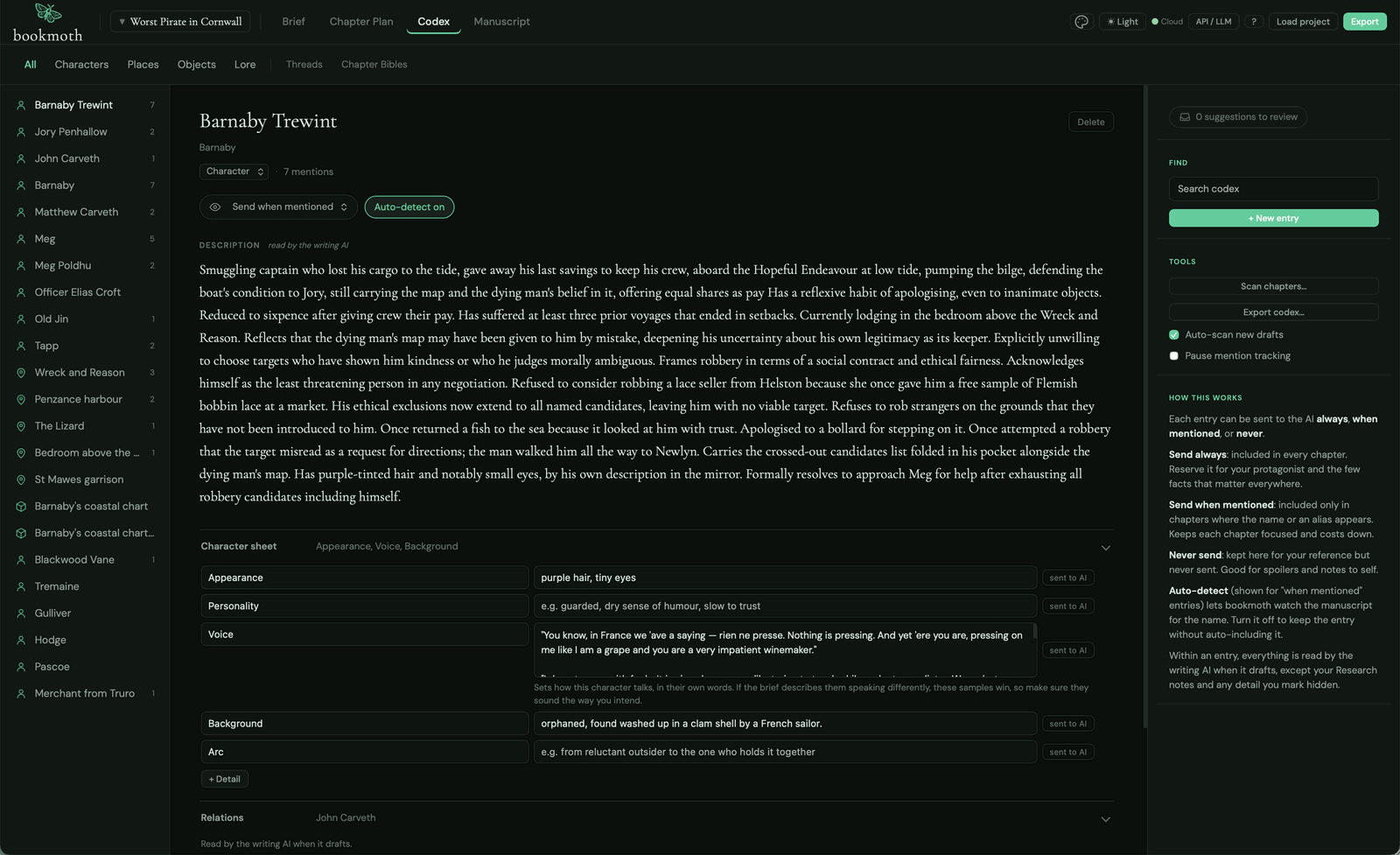
Characters, places, history: all remembered and kept straight for you, whether the AI writes a word or not.
As the book grows, bookmoth keeps track of who's who, where things happened, and what's already true, building your story bible as you write instead of making you do it by hand. It proposes new characters, places, and lore for your approval, and flags contradictions before they reach the page, so you never have to hold the whole world in your head or scroll back through forty chapters to check the colour of someone's eyes.
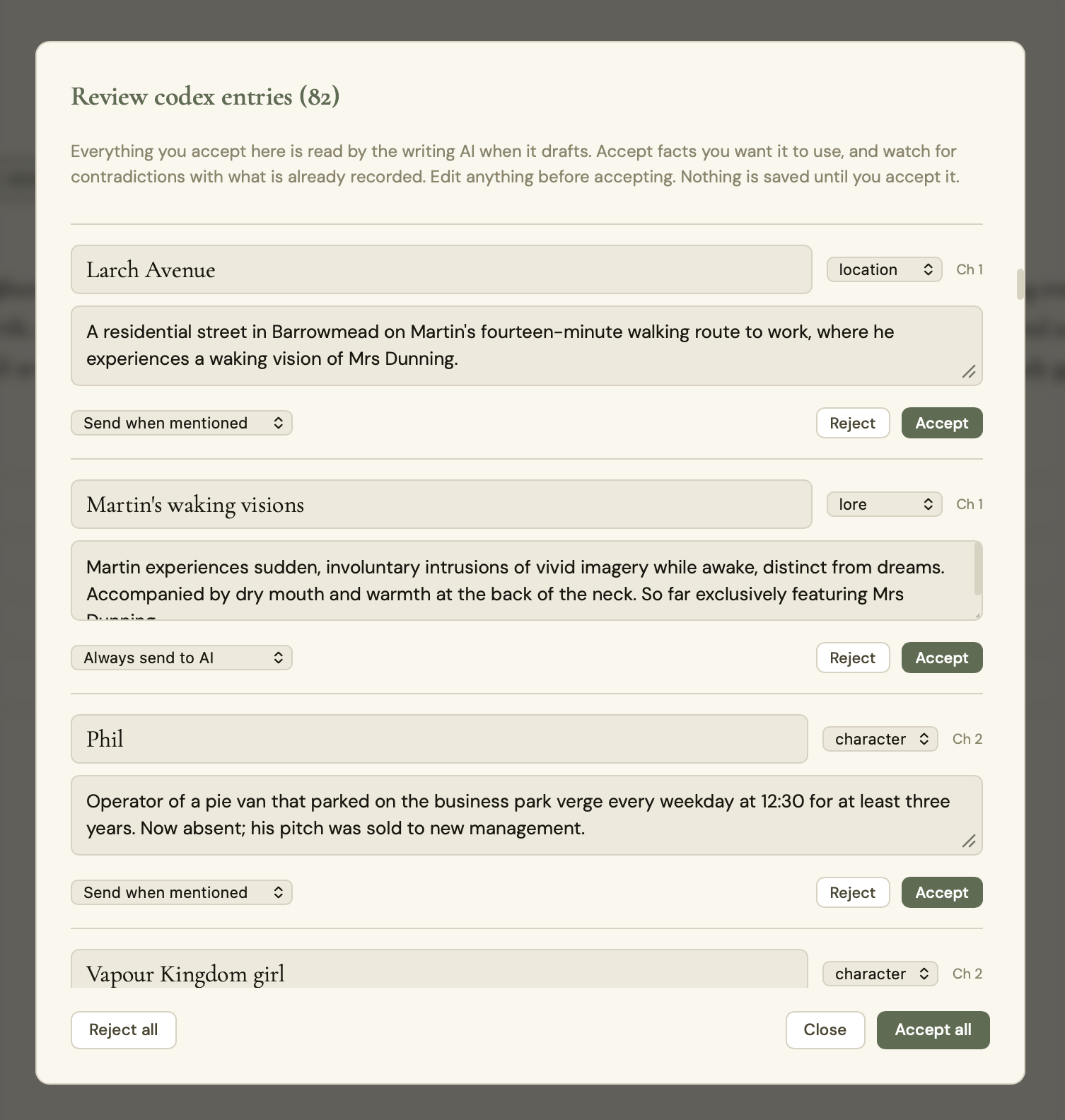
Aliases keep one person together however you name them across the book. Relationships map who knows whom, so your world holds together as it grows. And if you ever want a hand with a line of dialogue, give a character a few example lines and bookmoth will match their voice, the same way it matches yours.
The editor
A conversation inside your manuscript, always reading your live prose.
Highlight a sentence and say what you want, and the editor proposes a change to just that selection, shown as a diff you accept or dismiss. Ask for a structural read and it answers like a colleague who already knows your book. Ask it to read a finished chapter and it brings your story plan and codex up to date, every change filed for your review and named, so you always know exactly what moved.
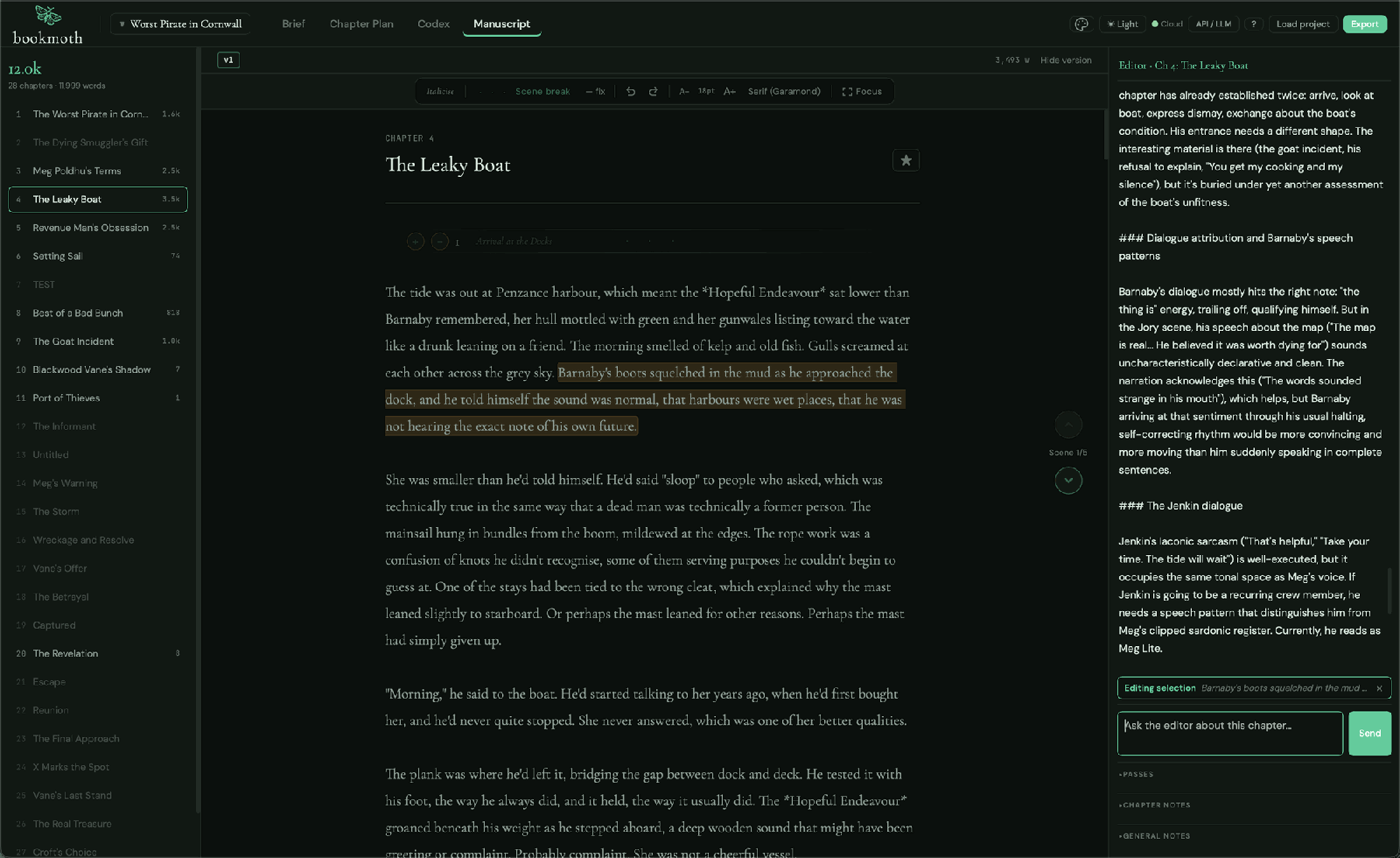
Tighten a passage, raise the tension, or check continuity, all in plain language with the whole book in context.
Select a passage, describe the change, and it lands only there, shown as a reviewable diff.
Every change goes through a diff you review and saves as a version you can roll back.
The companion Beta
A companion app for iPhone and iPad, so the chapter you left on the desktop is with you on the train. Your projects sync through your own iCloud, and nothing of yours ever touches a bookmoth server.
Now in beta on iPhone and iPad. Read and write anywhere, then pick up on the desktop exactly where you stopped.
Themes
Three colourways, each with a light and a dark, and a live picker that reskins the whole app as you flip between them. bookmoth, Paradice, and Mithril. Or build your own custom theme, with a light and a dark of its own.
Paste a few paragraphs. Get a free voice portrait by email. No account needed, no strings. Just an honest editorial read of your prose. Works in most major languages.
Get your voice portrait
See it work


Ask the Editor reads your chapter in the context of your entire manuscript, your brief, and your voice profile. Structural, tonal, and craft-level notes.
Every chapter carries its own versions. Draft, revise, start fresh. Your earlier work is always there. Nothing is overwritten, nothing is lost.
No account. No cloud. No analytics. Your manuscript, your brief, your writing profile: all stored on your machine.
One fee. No subscription. Ever.
Bring your own API key (Anthropic, OpenRouter, or a local model). You pay your provider only for the AI you use, and you choose the models. You control your spend.
You buy bookmoth once. Updates are free, forever. No tiers, no usage caps.
The only running cost is the AI itself, billed by your provider, not us. What you spend depends on what you ask for. Drafting a chapter is the big one, from a couple of cents to around 30 cents depending on the model. Lighter jobs cost less each time, but they add up across a long book: editor chat, and scanning your chapters to build the codex.
You stay in control. Claude gives the best prose, but you can point bulk jobs like codex scanning at a cheaper model, a smaller Claude, a budget model on OpenRouter, or a free local one, and keep Claude for the writing. Every cent shows up in your provider's dashboard.
Most AI writing subscriptions charge $19 to $29 a month. bookmoth is one payment. A subscription overtakes what bookmoth costs within a few months, then keeps billing every month after. Pay for bookmoth once and you are done.
$99. Once. No subscription. Free updates forever.
